Popular Posts

Showing posts with label Khamenei. Show all posts

Wednesday, August 2, 2017

New US Sanctions, Iran and Massacre of 30,000 Political Prisoners


Adoption of a bill by both chambers of the US Congress, imposing new sanctions on Iran, has terrified the Iranian regime. The sanctions includes Iran’s ballistic missile program, terrorism, and violation of Human Rights.


Sunday, July 23, 2017

Iran: At least 2300 pre-school kids live in prisons

 23 July 2017

The number of pre-school children who live in Iranian prisons along with their mothers has reached 2300.
Mohammad Javad Fat’hi, member of the judicial committee of the Iranian parliament, announced on July 22, 2017, that 2300 kids are in prisons along with their parents, a situation which is “very strange” and “needs to be deliberated on.”

Iran’s Most Feared Mullah Acknowledges Massacre of Political Prisoners


Iran massacred over 30,000 political prisoners in summer of 1988 and kept a lid on this atrocity for three decades. In this year’s presidential election a conservative cleric by the name of Ebrahim Raisi, one of the perpetrators of the massacre, was selected as a main candidate, resurfacing the 1988 massacre and forcing regime officials, one after another, to confess about the carnage.

ANALYSIS: Unveiling the secrets of Iran’s 1988 massacre
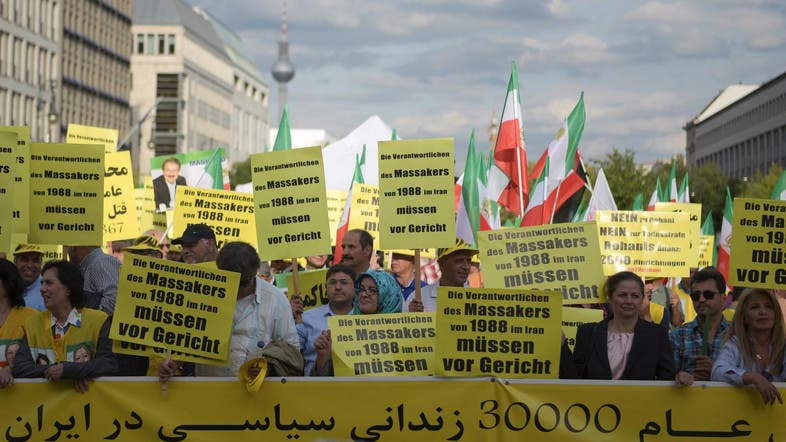

Activists in Berlin hold banners reading ‘The people responsible for 1988 massacres need to be brought to court’, on September 3, 2016. (Reuters)
Ali Fallahian, Iran’s intelligence minister during the tenure of Rafsanjani’s presidency back in the early 90s, is a name most notoriously known for his role in a series of chain murders across the country that saw the elimination of many dissidents.
Fallahian has recently been heard making shocking revelations in reference to mass executions, especially targeting members and supporter of the Iranian opposition People’s Mojahedin Organization of Iran (PMOI/MEK).
A German court raised charges against Fallahian for his direct involvement in the September 1992 assassination of Iranian Kurdish dissidents in Berlin. In 2007, Interpol placed Fallahian on its most wanted list for his role in the 1994 bombing the AMIA in Buenos Aires Jewish center that left 85 killed.
The 1988 massacre of over 30,000 political prisoners, mostly MEK members and supporters, has in the past year inside Iran become a major issue for the general public, especially the younger generation who are beginning to demand answers.
Fallhian’s remarks, aired in a recent interview, have caused quite a stir in social media inside Iran and amongst Iranian communities living abroad. In this interview, Fallahian sheds light on his role in the Iranian regime’s die-hard enmity against the MEK as the only opposition truly threatening their rule.


 in 
just in a month Khomeini issued a fatwa that gave open hand to his ayatollahs to kill ppl !!

Q: “Can we blame only the MEK for taking up arms, or did we also make mistakes… for example, attack their gatherings, pressure their members and supporters...?”
Fallahian: “They had such an analysis. [Iranian opposition leader Massoud] Rajavi had maybe written 36 articles against armed conflicts.” (Khazar website – July 18) This is Fallahian acknowledging the fact that the MEK had sought to continue their peaceful political activities. The mullahs’ regime, however, dispatched their forces to attack, arrest, torture and kill MEK members. Fallahian moves on to discuss the 1988 mass executions across Iran.
Q: “Did the Intelligence Ministry suggest the 1988 executions to [Iranian regime founder Ruhollah] Khomeini?”
Fallahian: “Khomeini himself ordered it… saying the ruling for all moharebs [term used for MEK members, meaning enemies of God] is execution. There were discussions in this regard back then. Mr. Mousavi Tabrizi believed there was no need for prosecution, arguing prosecuting those who are at war with us has no meaning. Others believed those arrested should be prosecuted… however, [Khomeini] constantly emphasized to beware they don’t slip out of your hands… [Khomeini] would always say be careful in this regard… how? For example, if there was a confusion about someone being a murderer or not, execution would not be the first option of punishment. However, about the MEK [Khomeini] would say an opposite approach is needed. I know them, he would say, they must not slip away and their rulings are execution. This was his constant ruling, before and after the 1988 issue…
“… there are discussions and some are asking why were those sentenced to prison terms again condemned to death? First of all, keep in mind their rulings are execution, even if a judge hadn’t ruled for an execution, he had violated the law… If an armed mohareb was arrested, his/her ruling would be execution, even if he/she hadn’t killed anyone… the ruling for a hypocrite (another term used for MEK members) and mohareb is execution. This was [Khomeini’s] fatwa. There was no discussion in this regard. In 1988… the discussion reached the point that all of them must be executed, even those not sentenced to death. [Khomeini] would ask why have you still kept them alive.”
It is worth noting that the Iranian opposition has for the past year launched a justice movement shedding light on the 1988 massacre both inside Iran and across the globe. These efforts went into full gear weeks prior to Iran’s May 19th presidential election, forcing Supreme Leader Ali Khamenei to sack his plans of engineering election results as he desired.
Conservative cleric Ebrahim Raisi, known to be Khamenei’s preferred candidate to replace the incumbent Hassan Rouhani as president, suffered a major defeat due to revelations of his role in the 1988 massacre. Raisi was a member of the notorious four-man “Death Commission” appointed by Khomeini himself to facilitate and hasten the execution process.
Q: “Raisi was in the commission. Who were the other members?”
Fallahian, however, refrains from naming other Death Commission members and begins discussing the process which political prisoners were executed and the summer 1988 massacre. He placed all the blame on Khomeini, emphasizing he had issued the execution and massacre ruling long before.”
Fallhian: “Yes, the poor guy [referring to Raisi] insisted he hadn’t issued the ruling, the ruling was issued in advance… but no one would listen, and they would also think the executed were innocent… if we hadn’t killed them there would be no country today. These are not my words, they are the words of [Khomeini]…”
The reporter seeks to make a reference to a groundbreaking sound file unveiled last September of Khomeini’s then successor, the late Hossein Ali Montazeri, in which he sheds light on unknown aspects of the 1988 massacre.

Q: “What was Mr. Montazeri’s mistake?”
Fallahian: “He came in disagreement with [Khomeini]… [He] believed history would judge these executions against us and Islam. He would say it would be better to refrain, as when the enemy begins to write, they won’t cite us harshly. However, [Khomeini] ordered to carry out your religious duty and don’t wait for history’s judgement.”
Q: “Were all those executed arrested while armed?”
Fallahian: “No, not all of them were involved in the armed revolt. However, many of them were living in team houses. We would go there and find only one or two weapons, or arrest them on the street without any arms.”
Q: “So how were they linked to the armed revolt?”
Fallahian: “Well, they were part of the organization.”
Q: “Wasn’t it necessary for each individual to have taken up arms to be convicted of being a mohareb?”
Fallahian: “No, when someone is a member of an armed current, the individual being armed or not, their ruling is mohareb.”
Q: “Even if they are arrested with a newspaper?”
Here the interviewer is referring to the fact that many MEK members and supporters were arrested, and eventually executed, for the mere fact of having a pro-MEK newspaper at their possession.
Fallahian: “Yes. They were part of that organization and were operational. Now, its possible someone would merely buy bread for those living in ‘team houses’, another would, for example, procure other necessary items. They were all involved.”
On a side note, Fallahian referred to the extensive MOIS role in dispatching its spies abroad under various pretexts.

Former intel minister says Iran sends agents abroad posing as journalist & business people etc.; Iran regime agents in US must be prosecuted https://twitter.com/tarikhirani/status/886248371694051328 …

“… we do not dispatch an intelligence officer, let’s say to Germany, the US or Russia, and there he would say, ‘well, I am from the Ministry of Intelligence, please provide me your information.’ (They would do it) under the cover of business or media jobs. Many journalists are intelligence agents ... A journalist is not paid well, so he needs to work with an intelligence service."

Iran's former intelligence minister: "Many Iranian journalists abroad are intelligence agents...there's little money only in journalism" https://twitter.com/tarikhirani/status/886248371694051328 …

Revelations and shocking remarks about the 1988 massacre are made by numerous senior Iranian officials recently. What has made these figures acknowledge the nature of the mullahs’ regime of carrying out such massacres and mass murders?
This has been the true, yet unfortunately cloaked, nature of the mullahs ruling Iran. Nearly three decades after that horrific summer of 1988, the efforts placed by the Iranian opposition through its vast network of brave activists inside the country and abroad have forced the mullahs to literally confess to their role in these killings.
It is now high time for the international community to demand a fact-finding mission, and bring to justice all perpetrators of the 1988 massacre and all the atrocious human rights violations throughout the past 38 years.

Saturday, July 22, 2017

ANALYSIS: Unveiling the secrets of Iran’s 1988 massacre


By Heshmat AlaviSpecial to Al Arabiya EnglishSaturday, 22 July 2017

Ali Fallahian, Iran’s intelligence minister during the tenure of Rafsanjani’s presidency back in the early 90s, is a name most notoriously known for his role in a series of chain murders across the country that saw the elimination of many dissidents.
Fallahian has recently been heard making shocking revelations in reference to mass executions, especially targeting members and supporter of the Iranian opposition People’s Mojahedin Organization of Iran (PMOI/MEK).
A German court raised charges against Fallahian for his direct involvement in the September 1992 assassination of Iranian Kurdish dissidents in Berlin. In 2007, Interpol placed Fallahian on its most wanted list for his role in the 1994 bombing the AMIA in Buenos Aires Jewish center that left 85 killed.
The 1988 massacre of over 30,000 political prisoners, mostly MEK members and supporters, has in the past year inside Iran become a major issue for the general public, especially the younger generation who are beginning to demand answers.
Fallhian’s remarks, aired in a recent interview, have caused quite a stir in social media inside Iran and amongst Iranian communities living abroad. In this interview, Fallahian sheds light on his role in the Iranian regime’s die-hard enmity against the MEK as the only opposition truly threatening their rule.
Q: “Can we blame only the MEK for taking up arms, or did we also make mistakes… for example, attack their gatherings, pressure their members and supporters...?”
Fallahian: “They had such an analysis. [Iranian opposition leader Massoud] Rajavi had maybe written 36 articles against armed conflicts.” (Khazar website – July 18) This is Fallahian acknowledging the fact that the MEK had sought to continue their peaceful political activities. The mullahs’ regime, however, dispatched their forces to attack, arrest, torture and kill MEK members. Fallahian moves on to discuss the 1988 mass executions across Iran.
Q: “Did the Intelligence Ministry suggest the 1988 executions to [Iranian regime founder Ruhollah] Khomeini?”
Fallahian: “Khomeini himself ordered it… saying the ruling for all moharebs [term used for MEK members, meaning enemies of God] is execution. There were discussions in this regard back then. Mr. Mousavi Tabrizi believed there was no need for prosecution, arguing prosecuting those who are at war with us has no meaning. Others believed those arrested should be prosecuted… however, [Khomeini] constantly emphasized to beware they don’t slip out of your hands… [Khomeini] would always say be careful in this regard… how? For example, if there was a confusion about someone being a murderer or not, execution would not be the first option of punishment. However, about the MEK [Khomeini] would say an opposite approach is needed. I know them, he would say, they must not slip away and their rulings are execution. This was his constant ruling, before and after the 1988 issue…
“… there are discussions and some are asking why were those sentenced to prison terms again condemned to death? First of all, keep in mind their rulings are execution, even if a judge hadn’t ruled for an execution, he had violated the law… If an armed mohareb was arrested, his/her ruling would be execution, even if he/she hadn’t killed anyone… the ruling for a hypocrite (another term used for MEK members) and mohareb is execution. This was [Khomeini’s] fatwa. There was no discussion in this regard. In 1988… the discussion reached the point that all of them must be executed, even those not sentenced to death. [Khomeini] would ask why have you still kept them alive.”
It is worth noting that the Iranian opposition has for the past year launched a justice movement shedding light on the 1988 massacre both inside Iran and across the globe. These efforts went into full gear weeks prior to Iran’s May 19th presidential election, forcing Supreme Leader Ali Khamenei to sack his plans of engineering election results as he desired.
Conservative cleric Ebrahim Raisi, known to be Khamenei’s preferred candidate to replace the incumbent Hassan Rouhani as president, suffered a major defeat due to revelations of his role in the 1988 massacre. Raisi was a member of the notorious four-man “Death Commission” appointed by Khomeini himself to facilitate and hasten the execution process.
Q: “Raisi was in the commission. Who were the other members?”
Fallahian, however, refrains from naming other Death Commission members and begins discussing the process which political prisoners were executed and the summer 1988 massacre. He placed all the blame on Khomeini, emphasizing he had issued the execution and massacre ruling long before.”
Fallhian: “Yes, the poor guy [referring to Raisi] insisted he hadn’t issued the ruling, the ruling was issued in advance… but no one would listen, and they would also think the executed were innocent… if we hadn’t killed them there would be no country today. These are not my words, they are the words of [Khomeini]…”
The reporter seeks to make a reference to a groundbreaking sound file unveiled last September of Khomeini’s then successor, the late Hossein Ali Montazeri, in which he sheds light on unknown aspects of the 1988 massacre.
Q: “What was Mr. Montazeri’s mistake?”
Fallahian: “He came in disagreement with [Khomeini]… [He] believed history would judge these executions against us and Islam. He would say it would be better to refrain, as when the enemy begins to write, they won’t cite us harshly. However, [Khomeini] ordered to carry out your religious duty and don’t wait for history’s judgement.”
Q: “Were all those executed arrested while armed?”
Fallahian: “No, not all of them were involved in the armed revolt. However, many of them were living in team houses. We would go there and find only one or two weapons, or arrest them on the street without any arms.”
Q: “So how were they linked to the armed revolt?”
Fallahian: “Well, they were part of the organization.”
Q: “Wasn’t it necessary for each individual to have taken up arms to be convicted of being a mohareb?”
Fallahian: “No, when someone is a member of an armed current, the individual being armed or not, their ruling is mohareb.”
Q: “Even if they are arrested with a newspaper?”
Here the interviewer is referring to the fact that many MEK members and supporters were arrested, and eventually executed, for the mere fact of having a pro-MEK newspaper at their possession.
Fallahian: “Yes. They were part of that organization and were operational. Now, its possible someone would merely buy bread for those living in ‘team houses’, another would, for example, procure other necessary items. They were all involved.”
On a side note, Fallahian referred to the extensive MOIS role in dispatching its spies abroad under various pretexts.
“… we do not dispatch an intelligence officer, let’s say to Germany, the US or Russia, and there he would say, ‘well, I am from the Ministry of Intelligence, please provide me your information.’ (They would do it) under the cover of business or media jobs. Many journalists are intelligence agents ... A journalist is not paid well, so he needs to work with an intelligence service."
Iran's former intelligence minister: "Many Iranian journalists abroad are intelligence agents...there's little money only in journalism" https://twitter.com/tarikhirani/status/886248371694051328 …
Revelations and shocking remarks about the 1988 massacre are made by numerous senior Iranian officials recently. What has made these figures acknowledge the nature of the mullahs’ regime of carrying out such massacres and mass murders?
This has been the true, yet unfortunately cloaked, nature of the mullahs ruling Iran. Nearly three decades after that horrific summer of 1988, the efforts placed by the Iranian opposition through its vast network of brave activists inside the country and abroad have forced the mullahs to literally confess to their role in these killings.
It is now high time for the international community to demand a fact-finding mission, and bring to justice all perpetrators of the 1988 massacre and all the atrocious human rights violations throughout the past 38 year

Friday, July 21, 2017

A TRIBUTE TO ZOHREH, WHO TAUNTED HER TORTURERS IN IRAN

19 July 2017
By Hassan Mahmoudi
The dictators commit crimes to keep the power for a longer time. On the other hand, there are always people who stand against them and pay the price for freedom. In the recent history we have Hitler and Khomeini. One has been defeated and somehow brought to justice and the other one have not been yet, but will be. Khomeini killed 120.000 people to survive its ruling.

Iran's Supreme Leader and Anti-MEK Movie


By Jubin Katiraie
On July 15th state media in Iran fully covered the remarks of Supreme Leader Ali Khamenei about a movie called, “The Adventure of Midday”.
Following the ignominy of this movie which was produced against the People’s Mujahedin Organization of Iran ( PMOI/MEK), the news agency of the Islamic Revolutionary Guards (IRGC) released the news about the meeting of Iranian regime's Supreme Leader Ali Khamenei with film producers which depicts Khamenei’s role in the production of this movie. The Islamic Revolutionary Guards Corps (IRGC) was also involved in the production of the movie in February/March 2017.

IRAN REGIME'S SUPREME LEADER ROLE IN THE PRODUCTION OF MOVIES AGAINST MEK


 18 July 2017
By INU Staff
INU - Following the ignominy of the movie “Adventure of Nimrooz (Midday Adventure)", made against the People’s Mujahedin Organization of Iran ( PMOI/MEK), the news agency of the Islamic Revolutionary Guards (IRGC) released the news about the meeting of Iranian regime's Supreme Leader Ali Khamenei with film producers which exposes Khamenei’s role in the production of this movie. The IRGC was also involved in the production of the movie in February/March 2017.

Thursday, July 20, 2017

Iran's Supreme Leader and Anti-MEK Movie


By Jubin Katiraie

On July 15th state media in Iran fully covered the remarks of Supreme Leader Ali Khamenei about a movie called, “The Adventure of Midday”.
Following the ignominy of this movie which was produced against the People’s Mujahedin Organization of Iran ( PMOI/MEK), the news agency of the Islamic Revolutionary Guards (IRGC) released the news about the meeting of Iranian regime's Supreme Leader Ali Khamenei with film producers which depicts Khamenei’s role in the production of this movie. The Islamic Revolutionary Guards Corps (IRGC) was also involved in the production of the movie in February/March 2017.

WAR AND APPEASEMENT ARE NOT SOLUTIONS FOR IRAN

25 July 2017 London, 24 Jul - London, 24 Jul - As the Trump White House is reviewing its Iran policy there is increasing support for reg...